

Background
Standardized patients — trained actors presenting scripted clinical scenarios — are a key tool for measuring the technical quality of health care delivery (Daniels et al., 2023; Das et al., 2022). AI-MED extends this methodology into the digital domain, enabling at-scale deployment of interactive, pre-scripted patient simulations without the logistical constraints of in-person enumerators (Zhang et al., 2026). This approach has been evaluated in a pilot and validation study in Vietnam (Daniels et al., 2026).
Methodology
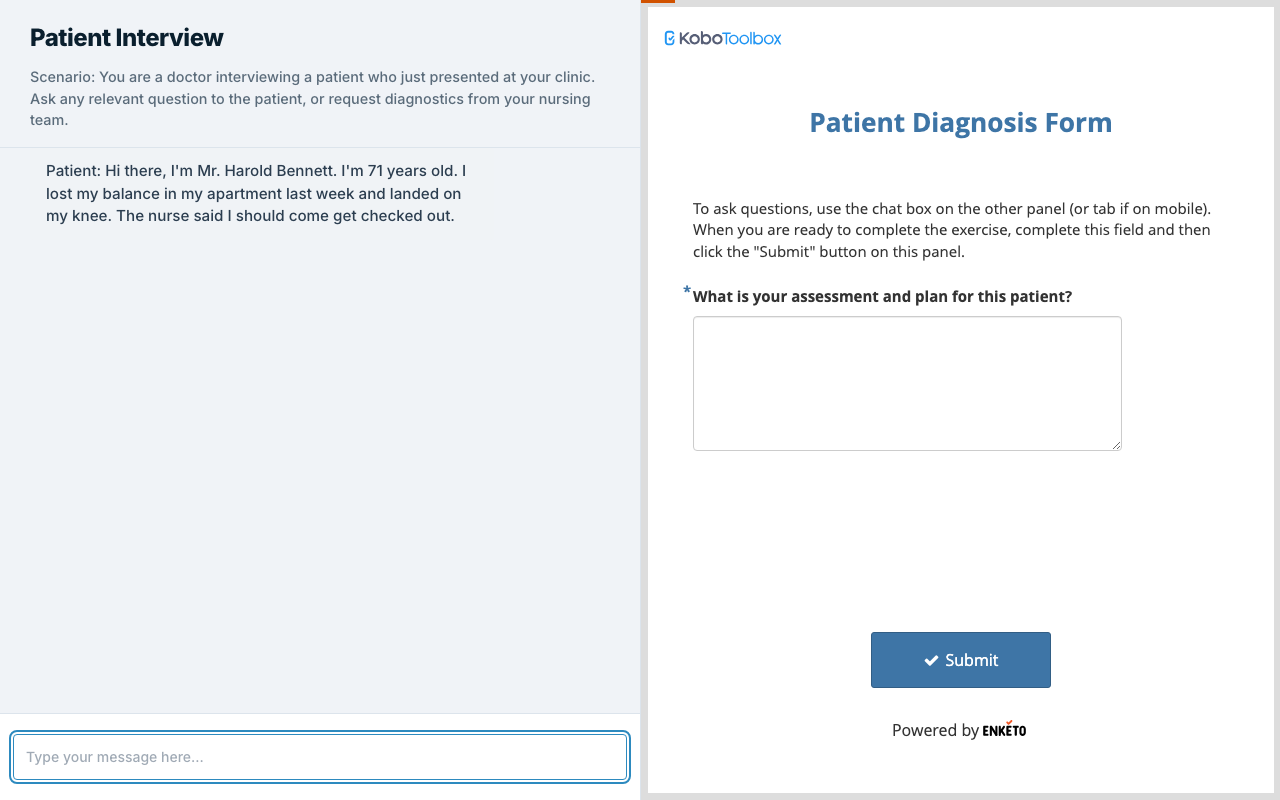
A provider opens a session and is presented with a simulated patient's initial complaint -- for example, "Doctor, I have been having a headache off and on for a while now." Providers then conduct natural-language clinical interviews with these LLM-driven patients generated from structured case vignettes, then submit diagnoses and other reactions through standardized survey instruments. Conversation transcripts and form responses are evaluated against clinical rubrics.
Webinar
A recorded webinar on using the AI-MED methodology to scale open-ended, AI-led patient interviews for clinical training and measurement.